Mark 9:42-50

Posted by Veronica on Mar 14th, 2010
2010
Mar 14

“Whoever causes one of these little ones who believe in me to sin, it would be better for him if a great millstone were hung around his neck and he were thrown into the sea.  And if your hand causes you to sin, cut it off. It is better for you to enter life crippled than with two hands to go to hell, to the unquenchable fire. And if your foot causes you to sin, cut it off. It is better for you to enter life lame than with two feet to be thrown into hell.  And if your eye causes you to sin, tear it out. It is better for you to enter the kingdom of God with one eye than with two eyes to be thrown into hell, ‘where their worm does not die and the fire is not quenched.’ For everyone will be salted with fire. Salt is good, but if the salt has lost its saltiness, how will you make it salty again? Have salt in yourselves, and be at peace with one another.”

Isaiah 45:18-19

Posted by Veronica on Feb 21st, 2010
2010
Feb 21

For thus says the Lord,who created the heavens
(he is God!),
who formed the earth and made it
(he established it;
he did not create it empty,
he formed it to be inhabited!):
“I am the Lord, and there is no other.

I did not speak in secret,
in a land of darkness;
I did not say to the offspring of Jacob,
‘Seek me in vain.’
I the Lord speak the truth;
I declare what is right.

Ezra’s Example

Posted by Veronica on Feb 7th, 2010
2010
Feb 7

“For Ezra had set his heart to study the law of the Lord, and to do it and to teach his statutes and rules in Israel.” Ezra 7:10

. 

Ezra set his heart – he made a decision, firmly, and intentionally purposed in his heart – to study God’s Word.

 .

To study is “to apply oneself to acquiring a knowledge of (a subject); to examine or investigate carefully and in detail; to observe attentively; scrutinize; to read carefully or intently; to endeavor to learn; to consider.”  (Dictionary.com)  Studying implies an attempt to obtain a grasp of something by methodical or exhaustive thought.

 .

Joshua 1:8 instructs us that, “This Book of the Law shall not depart from your mouth, but you shall meditate on it day and night, so that you may be careful to do according to all that is written in it.” Meditating on Scripture requires reading actively and thoughtfully, and lingering over the truths found in God’s Word.  As we do this, those truths will fill our hearts and minds. The more we internalize God’s Word, the more it will influence our daily life.  

.

Following Ezra’s example, the understanding that we gain from our study of and meditation on God’s Word should lead us to a life of obedience.

 .

Ezra set his heart to study God’s Word so that he could do it.

 .

James 1:22-25 tell us to “…be doers of the word, and not hearers only, deceiving yourselves.  For if anyone is a hearer of the word and not a doer, he is like a man who looks intently at his natural face in a mirror.  For he looks at himself and goes away and at once forgets what he was like.  But the one who looks into the perfect law, the law of liberty, and perseveres, being no hearer who forgets but a doer who acts, he will be blessed in his doing.”

.

A mirror is only an effective tool if we do something about the reflection that it offers.  It does no good to look in a mirror and discover that you have spinach in your teeth, or that your hair is sticking up, or your clothes are rumpled, if you walk away without even attempting to fix the problem.  In the same way, what good does it do to come to Scripture and be confronted with commands and principles that we are to obey, or sin that must be confessed and repented of, only to walk away and pretend as though nothing is wrong?

 .

Maybe you’ve heard the saying, “Those who can, do.  Those who can’t, teach.”  But, “Ezra set his heart to study the law of the Lord, and to do it and to teach his statutes and rules in Israel.” 

 .

Study.  Then do.  Then teach. 

 .

You cannot teach what you do not know.  And you should not teach what you will not do.  We must set our hearts to study God’s Word, and to practice what we have learned before we attempt to teach it to others.

 .

Study produces knowledge.  But, knowledge, without application, without obedience, without a change in thought or behavior will lead to arrogance.  Our knowledge must be turned into obedience.  And, as obedience leads to maturity, we are responsible to teach others.

 .

“For though by this time you ought to be teachers, you need someone to teach you again the basic principles of the oracles of God. You need milk, not solid food, for everyone who lives on milk is unskilled in the word of righteousness, since he is a child.”  ~Hebrews 5:12

 .

Have you intentionally and purposefully set your heart to study God’s Word, to do it, and to teach it?

1 Chronicles 16:8-12

Posted by Veronica on Jan 31st, 2010
2010
Jan 31

“Oh give thanks to the Lord; call upon his name;
make known his deeds among the peoples!
Sing to him; sing praises to him;
tell of all his wondrous works!
Glory in his holy name;
let the hearts of those who seek the Lord rejoice!
Seek the Lord and his strength;
seek his presence continually!
Remember the wondrous works that he has done,
his miracles and the judgments he uttered.”

New Year, New Plan

Posted by Veronica on Jan 2nd, 2010
2010
Jan 2


A few years ago, the accountability/Bible Study/small group that I was a part of, decided to read through the Bible in 90 days.  For some, it took a little longer, but, the important thing was that everyone was reading their Bible – all of it!  It was the first time some had ever done that!  And, it was a great experience for all of us…and, spiritual-life-changing for some.  And, I am excited to do it again (starting yesterday)…and blog through it with a little more regularity than last time!  (Just so we’re clear, I’m committing to reading daily, not necessarily blogging about my reading daily…although that might happen on occasion.  But I will try to be somewhat consistent about keeping the blog updated with what I am reading and learning.)

 .

Each Bible reading plan, I think, comes with it’s own set of unique challenges and benefits (always!).  This one is challenging in a way that year-long programs are not. The pace is definitely more of a sprint than a marathon.  And, the sheer amount of reading to be done each day can be a bit overwhelming for someone like me, who prefers a (much!) slower pace when it comes to in depth Bible study.  I like to make lists, outlines, do word studies, cross-reference…This plan doesn’t allow for that – in the same way.  For some, the challenge can be the time…Not necessarily the 90 days, but, rather the time spent doing the reading each day.  Depending on your personal reading (with comprehension) speed, reading each day’s portion can take anywhere from 30 minutes to about an hour.

 .

But, one of the things I like about this plan is that you read from Genesis to Revelation.  The maximum amount of time you spend in one book is about 5 days (for some of the longer books…less for the shorter ones).  This allows books/letters to be read as a whole, helping you to understand verses, passages, and other books in the (proper) context of the whole.  Robert Murray M’Cheyne said, “I fear many of you never read the whole Bible, and yet it is all equally divine. ‘All Scripture is given by inspiration of God, and is profitable for doctrine, for reproof, for correction and instruction in righteousness, that the man of God may be perfect.’ If we pass over some parts of Scripture we will be incomplete Christians.”  And, Don Whitney wisely asks, “How can one live on ‘every word that proceeds out of the mouth of God’ (Mt. 4:4) if he’s never even read every word?”

 .

This plan is simply one way of reading every word…and, I happen to think it is a great one! 

.

But, because I am assuming that there are at least a few people out there who have recently made it a goal to read through the Bible this year – and if not all of it, you have perhaps committed to reading it consistently.  (Ahem…New Year’s Resolutions, anyone?)  If 90 days isn’t for you, there are many other great plans that you could use:

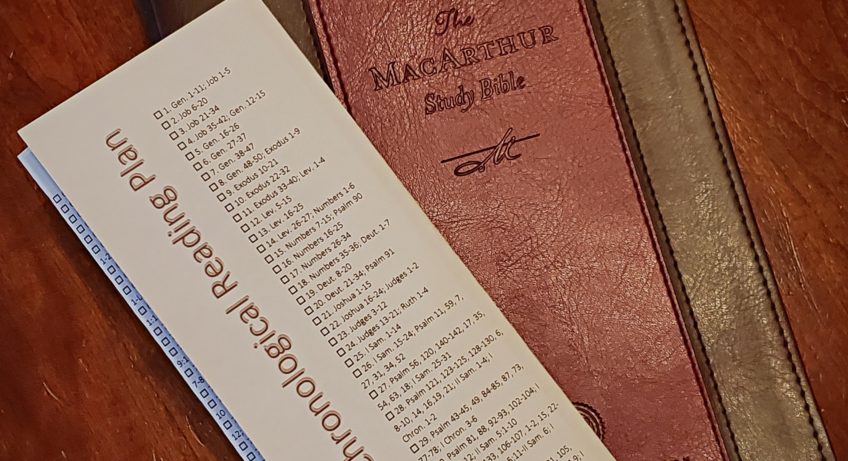
  • The Chronological Plan – This plan allows you to read though the Bible in the order in which the events occurred – which is not necessarily the way it is laid out in our Bible.
  • M’Cheyne’s Reading Plan – (This is the plan that our church recommends to those in the congregation who are interested in reading through their Bible in a year.) It is great because it gets you through the entire Bible in a year.  You will read through the Old Testament once, and the New Testament and Psalms twice.
  • The Bible in a Year/The One Year Bible – This is probably the most well-known plan for reading through the Bible each year.  It is a daily reading plan where you will read passages from the Old Testament, New Testament, Psalms, and Proverbs, each day.  (This link is to an online plan, which allows you to plug in your own start date.  So, if you did not, or could not start on January 1st, no worries!  You can still read through the Bible in a year, without feeling behind from the start!)
  • Donald Whitney’s Reading Plan (Scroll down to the section marked “Files related to meditation on Scripture” to find instructions for reading through Scripture in five places.  You can then open it in .doc format) – This plan will take you through five parts of Scripture per session – the Law, History, Poetry, the Prophets, and the New Testament – reading equal amounts in each.  (A variation on the plan is to read equal amounts daily in three sections, beginning in Genesis, Job, and Matthew.)
  • Prof. Horner’s Reading Plan – This plan was created by a professor at the college that I attended.  Similar to the above plan, you will read one chapter from 10 different sections of Scripture each day.  Each year, you will read through all 4 Gospels 4 times, the Pentateuch twice, Paul’s letters 4-5 times each, the OT wisdom literature six times, all the Psalms at least twice, all the Proverbs as well as Acts a dozen times, and all the way through the OT History and prophetic books about 1 ½ times. 

 .

I know that many of these plans, including the 90-day plan, offer Bibles specific to their plan, laid out to make the reading easier.  I understand why they do this, and I know many people find it helpful.  If you do, that’s great.  Truly, the important thing is that you are in the Word each day.  But…  Personally, I prefer to use my own Bible.  I do all of my reading in it.  I use it for study.  I carry it to church.  (You get the idea.)  Using the same Bible, regardless of which reading or study plan I am doing allows me to get to know “my” Bible.  I know where specific books, passages, and verses are in my Bible.  And, because I use the same version, for everything, I have found this to be of great help in memorization.   But, constantly switching up Bibles or versions can break the continuity, and the familiarity that I have with “my” Bible.  So, my suggestion would be to find a version (meaning translation, not paraphrase), print size, and format that you like, and stick with it.  Most of these plans also offer bookmarks, or printouts to help you stay on track, and keep your place.

.

I’d love to know what (if any) plan you are using this year.  And, if you’re up for it, I’d love it if you would…

If you do decide to join in…be sure to link up here.